
How Fermi Poker Fosters Cognitive Empathy

Classic Fermi problems ask you to make a quick, order-of-magnitude estimate of something seemingly unknowable: Chicago’s piano-tuner count, the number of new cars sold in the United States, or (more depressingly) how many chickens were killed for meat last year.
Fermi Poker turns that mental exercise into a social game: instead of cards, each player starts by writing down a guess to an estimation question. Multiple betting rounds follow, with two hint reveals in between. These hints help players evaluate their guesses and decide whether to stay in the round, and if so, how much to put at risk.
The twist is that you usually can't succeed just by being good at making Fermi estimates. You also have to model what's happening inside everyone else's head: their emotional state, background knowledge, risk tolerance, and ability to update their confidence when new information becomes available. In other words, Fermi Poker trains one of the core components of empathy: perspective-taking.
A Training Ground for Cognitive Empathy
Psychologist Nicholas Epley calls our chronic difficulty in guessing how others think "the real other-minds problem" and argues that failures of perspective-taking underlie many misunderstandings. Fermi Poker draws special attention to this psychological challenge and serves as a training ground to practice modeling others' knowledge and reasoning dozens of times in the course of a few hours.
This concentrated practice is effective because it works similarly to a flight simulator where pilots can practice dozens of takeoffs, landings, and emergency scenarios in a few hours. This is far more than they'd experience in months or even years of actual flying. Fermi Poker works the same way, letting you rehearse the core empathic move of understanding the minds of others at an iteration speed that is hard to replicate in everyday life.
Take that question about the number of new car sales in the US. Before you bet, you may ask yourself:
What do the others know about this topic?
Do they work in a car dealership or have they never even bought a car? Have they previously answered similar questions well?
How do they handle new information?
Some people quickly adjust their thinking when hints arrive; others stick stubbornly to their first impression.
What's their cultural background?
An American from rural Texas will likely estimate a much higher number than a European from a bike-friendly city.
What's their emotional state?
Did they just lose narrowly and now want to play aggressively to get back what they lost?
What do they know about me?
If they know I'm experienced with these questions but still bet big, they must be very confident.
The very act of constructing these mental dossiers trains a specific type of empathy that goes beyond reading physical tells. You're practicing cognitive empathy—the capacity to understand not just what someone is feeling, but how they think and why they believe what they believe.
Why Fermi Poker Outshines Traditional Poker for Empathy Training
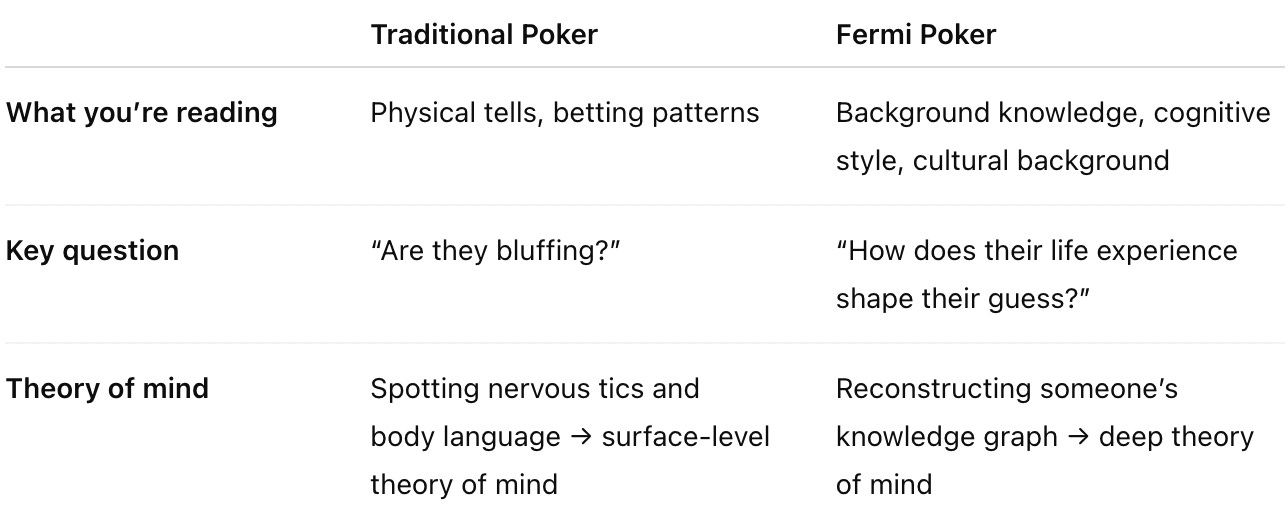
Traditional poker rewards reading tells: micro‑expressions, betting patterns, the occasional trembling hand. That’s valuable social perception, but the content of another player’s knowledge—their education, domain expertise, life experiences—rarely matters beyond guessing whether they understand pot odds.
Fermi Poker, by contrast, adds a rich layer of inference about why they believe what they believe. This is the kind of perspective-taking that transfers to real-world situations where you need to understand not just whether someone disagrees with you, but why they think differently.
Conclusion
Most empathy training focuses on helping people better recognize and respond to the emotions of others. But since emotional empathy is considerably more heritable than cognitive empathy (Abramson et al., 2020), this focus may be misdirected. Fermi Poker trains something different and more learnable: the ability to understand another person's reasoning process through conscious, deliberate practice.
Whether you're a teacher trying to understand why students approach problems differently, a negotiator working across cultural divides, or simply someone trying to have more productive conversations with people who see things differently, the ability to consciously model how others think might be one of the most valuable skills you can develop.